Moving agency from the hero to the route creates a compact design question: can players see how their own placement decisions change both risk and reward?
Steam Discovery Research · 4 min narrative + evidence · Checked 2026-09-08
Released · 2021-03-04 · Single-player · Four Quarters developed the game; Devolver Digital publishes it. Exact launch staffing is not verified here, and it is not labeled solo. Inspect dated Steam evidence →
Can indirect control feel deliberate rather than passive?
Agency lives outside the moving hero
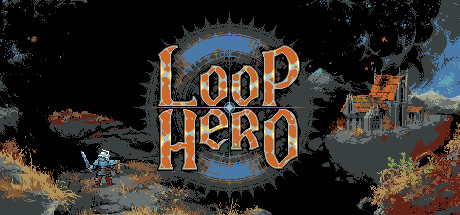
Loop Hero lets players place terrain, buildings and enemies along an expedition route while managing equipment and camp progress. Our interpretation is that this reverses a familiar relationship: the player helps construct the danger rather than only reacting to it. A prototype should make that responsibility visible at the moment a placement is chosen.
Official Steam posts record a developer interview broadcast before the March 2021 release, followed by a first-week audience announcement. Devolver Digital is credited as publisher. Those facts establish concrete promotional and release activity, but the available announcements do not reveal the marketing budget or isolate broadcast, publisher, creator and storefront contributions.
The first-week announcement says players, whereas a December developer statement reproduced by App2Top explicitly reports Steam copies sold. The latter supports a commercial breakout. It is not appropriate to silently relabel the earlier player count as sales, subtract the two figures into a sales curve, or convert either milestone into revenue without price and refund data.
Our proposed takeaway is to make a dangerous placement a conscious bargain. Give players one resource they need and one hazard that generates it, then ask them to predict the next circuit before committing. If failure feels arbitrary, improve the forecast instead of adding more card types. Test whether players can explain how they caused their own difficulty and whether they adjust the route on a retry. The goal is satisfying indirect control, not an endless simulation or a fully featured deckbuilder.
Turn additional risk into a placement decision with a visible payoff.
Change the expression
Use a clockwork delivery cart on a circular railway, placing stations and breakdown risks.
Proposed mini-demo
Build Clockline in 14 solo days: days 1–4 one fixed track and autonomous cart; 5–8 six placeable station tiles; 9–11 three circuits and one resource goal; 12–14 test eight players. No combat classes, camp or procedural world.
Technical cuts
Fixed simulation ticks, explicit next-circuit forecast and one resource. Defer adjacency explosions, loot tables and persistent construction.
Do not copy
Do not copy the loop cards, pixel presentation, camp systems or lore.
Proposed test
Before each circuit, ask players to predict the most dangerous segment and explain why they placed it. Continue if mistakes produce informed route changes rather than random retries.
These prototype ideas and gates are our proposals, not the original games’ production plans or validated market benchmarks.
What can go wrong
Indirect control can feel idle if cause and effect are unclear.
Adjacency rules and persistent resources quickly multiply balancing work.
Published player counts and copies require separate labels.
References & how we used them
5 source references. “Used for” identifies where this page relies on each source; it does not mean the author endorses our interpretation. Historical access notes are not fresh verification.
Steam · Author not recorded · Publication date not recorded
Used for: Narrative context: Agency lives outside the moving hero; Narrative context: A documented release, not an organic fairy tale; Evidence considered in our demand interpretation; Reported mechanism; causal explanation remains our inference
Data-page label, not an article title.
Earlier case access record (2026-09-08): public-api-verified. Verified official app 1282730, identity, release date, developer/publisher, modes and product text through Steam appdetails API: https://store.steampowered.com/api/appdetails?appids=1282730&l=english
Steam Community · Author not recorded · Publication date not recorded
Used for: Narrative context: A documented release, not an organic fairy tale; Campaign event: 2020-12-16 — Developer interview livestream / Steam announcement; Reported mechanism; causal explanation remains our inference
Data-page label, not an article title.
Earlier case access record (2026-09-08): public-api-verified. Read the full official announcement body and publication timestamp through Valve's ISteamNews/GetNewsForApp API (maxlength=0); resolved announcement URL returned HTTP 200.
Steam Community · Author not recorded · Publication date not recorded
Used for: Narrative context: A documented release, not an organic fairy tale; Campaign event: 2021-03-04 — Steam launch / release trailer; Reported mechanism; causal explanation remains our inference
Data-page label, not an article title.
Earlier case access record (2026-09-08): public-api-verified. Read the full official announcement body and publication timestamp through Valve's ISteamNews/GetNewsForApp API (maxlength=0); resolved announcement URL returned HTTP 200.
Steam Community · Author not recorded · Publication date not recorded
Used for: Narrative context: A documented release, not an organic fairy tale; Narrative context: Keep the milestones in their own units; KPI: First-week audience (First week after 2021-03-04 release; announced 2021-03-11); Campaign event: 2021-03-11 — Steam community milestone
Data-page label, not an article title.
Earlier case access record (2026-09-08): public-api-verified. Read the full official announcement body and publication timestamp through Valve's ISteamNews/GetNewsForApp API (maxlength=0); resolved announcement URL returned HTTP 200.
app2top.ru · Author not recorded · Publication date not recorded
Used for: Narrative context: Keep the milestones in their own units; KPI: Cumulative Steam sales (Developer statement dated 2021-12-08); Campaign event: 2021-12-08 — Developer social announcement; Evidence considered in our demand interpretation
Article title, author and date not yet recorded; follow the exact URL.
Earlier case access record (2026-09-08): public-full-text. Read the full public article, including its reproduction of the dated developer sales statement. Embedded original social post was inaccessible independently; limitation retained in the KPI.